
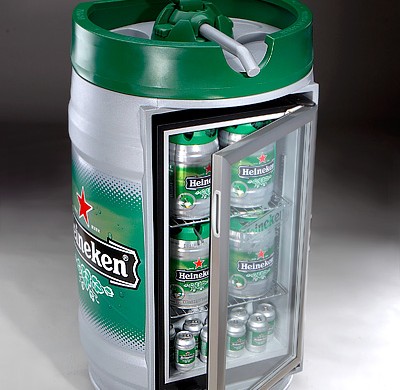

As a rotational molder with 80 years of plastic manufacturing experience, Gregstrom routinely receives inquiries from cooler designers. They’re interested in rotational molding because it can produce strong walls that withstand impacts and keep food and drink cold for extended periods of time. Yet some designers are more familiar with other plastics processes, such as injection molding.
As with any project, designers need to select a material. Often, LLDPE or HDPE plastics are used. UV-stabilized formulations are a good choice because they prevent color degradation and brittleness from prolonged sun exposure. Depending on where you are with your design, you may know this already. Still, there are some structural and engineering considerations to consider.
Uniform Wall Thickness and Thermal Insulation
Rotomolding distributes plastic resin along the inner surface of a heated mold. A target wall thickness of 0.150 to 0.250 inches can ensure impact resistance. Then there’s the hollow cavity between the double walls. It’s injected with a closed-cell polyurethane foam that expands to provide structural rigidity and thermal insulation.
Draft Angles and Demolding
Plastic shrinks as it cools inside the mold. That’s why proper draft angles are essential. Add a minimum draft angle of 3° to 5° on outer surfaces and 5° to 7° on deep internal cavities or ribs. This will allow the cooler body and lid to release cleanly without drag marks or warping.
Corner Radii & Stress Distribution
Sharp 90° corners create weak points and lead to uneven resin accumulation. Maintain generous corner radii of at least 0.25 to 0.50 inches on a rotomolded cooler’s interior and outer edges. This will promote smooth material flow and even wall distribution.
Ribbing and Panel Rigidity
Large flat panels on the cooler lid and body can flex under load. Add structural reinforcing ribs or kiss-off points where inner and outer walls meet. Adding subtle contoured geometric patterns across large surfaces can also add stiffness without introducing excess weight.
Are you ready to talk to a rotomolder and still looking for more information about how to design a rotomolded cooler? Talk to Gregstrom.


